PeerHelp
Ein Marktplatz und eine Nachhilfeplattform auf dem Campus, ausschließlich für verifizierte Studierende.
Dieser Artikel wurde maschinell aus dem Englischen übersetzt. Lesen Sie das Original
- Commits
- 84
- vergangenes Jahr
- Sterne
- 1
- Sprache
- TypeScript
- letzter Schub
- Mai 2026
Auf dieser Seite
Was es ist#
PeerHelp ist eine Campus-Plattform, auf der verifizierte Studierende Lehrbücher, Skripte, Klausuren vergangener Jahre und Laborausrüstung kaufen und verkaufen, Bücher für ein Semester ausleihen und Nachhilfestunden bei studentischen Tutoren buchen können. Nur Studierende, die ihre Zugehörigkeit zur Hochschule nachweisen, können Angebote einstellen, Nachrichten senden oder Nachhilfestunden anfragen.
Warum#
Auf dem Campus sind Lehrbücher eher ein logistisches als ein preisliches Problem. Das benötigte Buch steht in einem Regal im Wohnheim zwei Blocks weiter, und der Student aus einem höheren Semester, der den Kurs mit Bravour bestanden hat, würde gerne Nachhilfe geben. Doch WhatsApp-Gruppen verschwinden schnell und Schwarze Bretter veralten. PeerHelp ist das Verzeichnis und die Plattform, die diese Menschen miteinander verbindet. Dabei fließt kein Geld: Studierende bezahlen sich gegenseitig persönlich, wodurch das rechtliche Risiko minimal ist.
Stapel#
Next.js mit standardmäßigen Serverkomponenten wird auf Vercel bereitgestellt. Supabase stellt Postgres, Authentifizierung, Speicherung und Echtzeit-Funktionalität bereit, und die Zugriffskontrolle erfolgt datenbankseitig auf Zeilenebene. Resend versendet Einmalcodes und Benachrichtigungen, und ein eigens entwickelter Service Worker kümmert sich um Web Push. Beim Auflisten eines Lehrbuchs wird die ISBN per Webcam gescannt, wodurch Titel und Cover aus der Open Library automatisch eingefügt werden. Ich habe den Großteil des Codes geschrieben, mit Beiträgen von Rishita Shaw , Shrestha Saha und Sayantika Boral .
Der schwierige Teil#
Vertrauen. Studierende verifizieren sich per Hochschul-E-Mail-Code oder einem manuell geprüften Dokument. Jede Bild-URL wird beim Speichern überprüft, sodass der Client keine beliebigen Links speichern kann. Nachrichten werden ausschließlich über Datenbankfunktionen geschrieben, die Sperrlisten und Thread-Zugehörigkeit prüfen. Ratenbegrenzungen sind in einer Postgres-Tabelle hinterlegt, sodass ein Serverless-Kaltstart sie nicht zurücksetzen kann. Sobald ein Deal angenommen wurde, werden die Schlüsselfelder des Angebots gesperrt und die API antwortet mit dem 423 Locked .
Status#
Live und instand gehalten.
README.md
MeAshikeqbal/peerhelp · master
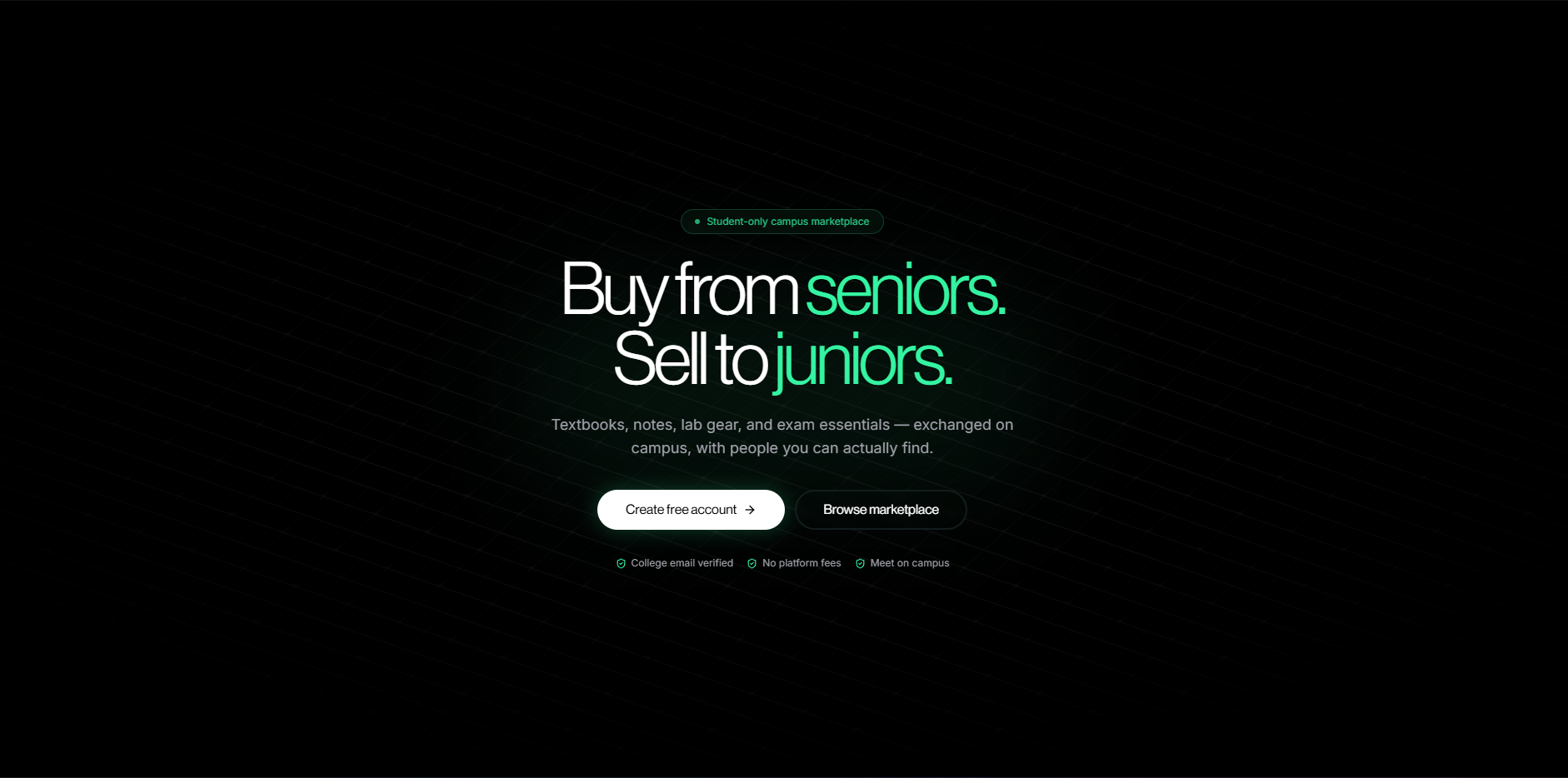

Buy from seniors. Sell to juniors. Learn from peers.
A verified-student-only campus platform for textbooks, notes,
lab gear, exam essentials, and peer tutoring — exchanged on campus,
with people you can actually find.
Features · Stack · Database · Architecture · Running locally · Roadmap
The problem
College textbooks aren't a software-licensing problem — they're a logistics problem.
The book you need is sitting on a shelf in the hostel two blocks over, owned by someone who would gladly sell it for a third of the campus-store price. You just don't know who, and they don't know you exist. The senior who aced your exact course would tutor you for ₹200/hr — but there's no way to find them.
Existing solutions leak value at every step: WhatsApp groups disappear, random noticeboards go stale, seniors graduate without ever connecting to the juniors who need their stuff.
PeerHelp is the directory + reputation + tutoring layer that makes the handoff obvious.
| What we do | What we don't do |
|---|---|
| Connect students who want to trade | Hold your money |
| Verify college identity via OTP + document review | Act as a payment processor |
| Record reputation after trades | Allow anonymous listings |
| Surface hostel / dept metadata for quick meetups | Let outsiders browse or bid |
| Match verified peer tutors with learners | Charge a platform fee |
| Enable in-app messaging between parties | Store payment credentials |
✦ Feature tour
Marketplace — Books & Study Materials
- Books with ISBN barcode scanner (webcam, via
@zxing/browser) and Open Library auto-fill for cover art + title — listing a textbook takes 20 seconds. - Study materials as a first-class listing type:
notes,past-year-questions(PYQ),pdf,rental— with subject tagging and material-type filters. - Smart filters that match how students shop: department, hostel, year of study, condition, price range, listing type, material type.
- Image hosting scoped per-user inside a Supabase Storage bucket. Server-side URL validation on every write — the client never gets to inject arbitrary image URLs.
openlibrary.org,books.google.com, andimages.isbndb.comare safelisted for ISBN-derived covers. - Public marketplace at
/marketplace— unauthenticated browse with pagination. Verified listing detail pages at/marketplace/[id]. - Rental listings — books can be listed as rentals with flat or per-day pricing plus a security deposit. Duration and return dates are tracked on the deal.
Deals & listing lifecycle
ACTIVE ──▶ RESERVED ──▶ COMPLETED
   │            │
└────────────┴──▶ CANCELLED-
Deal flow: buyer requests → seller accepts (listing becomes
reserved) → meet on campus → mark complete → ratings unlock. -
Rentals with per-day or flat pricing, security deposit, proposed start date, and duration.
rental_start_date,rental_end_date, andreturn_confirmed_atare recorded on both sides of the deal. -
Partial lock — once a deal is
acceptedorcompleted, the PATCH route enforces a field-level freeze:Field Locked? Reason title,condition,price🔒 Buyer agreed to these image_url,material_type,subject🔒 Identity fields description,hostel,department,year✏️ Pickup info — seller can still coordinate Violating the lock returns
HTTP 423with alockedFieldspayload. The UI disables locked inputs and shows an amber banner. -
Bilateral ratings after deal completion, surfaced on each seller's public profile card.
-
Buyer deal requests panel in the dashboard — buyers track all their pending, accepted, and historical deals.
-
Seller deal requests panel — sellers see incoming requests and can accept or decline each one.
Peer Tutoring
- Tutor profiles — any verified student can create a public tutor profile with a headline, bio, subjects (up to 8), teaching mode (
online/in_person/hybrid), hourly rate, availability note, languages, and experience. - Public tutor directory at
/tutors— paginated, searchable by keyword, filterable by subject and mode. Accessible to anyone (no login required to browse). - Session requests — verified students can send a session request to any active tutor, specifying subject, mode, proposed time, and a message. Tutors accept, decline, or mark complete.
- Mutual exclusion — a student cannot send a session request to themselves. Only one active profile is allowed per user.
- Dashboard sections for both sides:
/dashboard/tutoringfor tutor profile management and incoming requests,/dashboard/tutoring/learningfor session requests you've sent. - Status lifecycle:
pending → accepted → completedorpending → declined / cancelled. - Tutor notifications — session request received and request responded events are delivered in-app, by email, and as Web Push.
In-app Messaging
- 1-on-1 threads scoped to an existing deal or tutor session request. Each deal/request gets exactly one thread (enforced by a unique index on
context_type + context_id). - Realtime delivery via Supabase Realtime postgres_changes — messages arrive instantly without polling. The sidebar thread list also updates live on
INSERTtomessagesfor the current user. - Read receipts —
message_readstracks last-read timestamp per (thread, user). Unread badge counts are derived client-side. - Block list — any user can block another. Blocked parties cannot send messages. Block/unblock managed via
/api/users/[id]/blockand listed in profile settings (BlockedUsersList). - Reporting — users can report a thread or individual message. Reports land in
message_reportsand are reviewed in the admin panel. - SECURITY DEFINER RPCs — direct INSERT/UPDATE on
message_threadsandmessagesis not permitted via RLS. All writes go through Postgres RPCs that enforce participation, block-list, and length checks. - Dashboard at
/dashboard/messages— responsive split-panel UI with thread sidebar and message view.
Identity & trust
- Two verification paths:
- Email OTP — student enters their college email; a 6-digit OTP is sent via Resend. Verifies in seconds.
- Manual document review — student uploads an ID document (ID card, fee receipt, etc.) for admin review. Stored in a private
verification-documentsSupabase Storage bucket.
- Admin verification queue at
/admin/verifications— admins can approve, reject, or request changes on any pending submission. All decisions are logged inverification_audit_log. - Verification status on
profiles:pending→verified(orrejected). All listing and deal actions requireverifiedstatus. - Re-verification flow for stale records, with a
ReverifyButtoncomponent in profile settings. - Durable rate limiting — throttle state lives in the
rate_limit_attemptsPostgres table, not in memory. A serverless cold start cannot reset your counter. OTP, upload, and admin actions each have separate rate-limit types. - Row-Level Security everywhere — direct database access respects
auth.uid()-scoped policies. Storage bucket policies enforce{auth.uid()}/*paths.
Notifications
- In-app notifications via a
notificationsPostgres table + Server-Sent Events stream at/api/notifications/stream. - The nav bell (
NotificationBell) updates live without client-side polling. Notifications are marked read on open. - Email notifications via Resend — each notification type maps to a transactional email template. Users can opt out per-type via
notification_preferences. - Web Push — VAPID-based push notifications delivered to installed PWA instances. Subscriptions stored in
push_subscriptionswith per-device endpoints. Opt-in toggle in profile settings (PushSubscribeButton). Push fires alongside every in-app notification event. - Notification types:
deal_requested,deal_accepted,deal_declined,deal_cancelled,deal_completed,rating_received,verification_approved,verification_rejected,verification_changes_requested,tutor_request_received,tutor_request_responded,message_received.
Admin Panel
- Role-based access —
admin_userstable withreviewerandsuperroles.is_admin()/is_super_admin()Postgres helper functions gate all admin RLS policies and route handlers. - Verification dashboard at
/admin/verifications— review queue with full document viewer, approve/reject/request-changes actions, and audit log. - Message reports queue at
/admin/reports— admins can view reported threads with full message context, and mark reports as reviewed or dismissed. - Stats overview at
/admin— live counts of pending/approved/rejected verifications. - Cron job —
/api/admin/cron/purge-documentsruns hourly (Vercel Cron) to delete stale verification documents per retention policy. Protected by aCRON_SECRETbearer token.
PWA
- Installable —
manifest.webmanifestwith brand icons generated at runtime vianext/og.display: standalone,theme_color: #36F4A4. - Offline shell — hand-rolled service worker (
public/sw.js). Static assets and/_next/static/*are cache-first. Navigations fall back to/offlinewhen the network is unavailable./api/*and/auth/*are always network-only to prevent cross-user auth leaks. - Install banner — custom
beforeinstallpromptUI with iOS share-sheet fallback. Dismissal suppressed for 30 days vialocalStorage. - Silent updates — new service worker activates and auto-reloads in the background.
- Push on click — push notification click opens the relevant deep link (
/dashboard/deals,/dashboard/messages,/student-verification, etc.).
⚡ Tech stack
| Layer | Choice | Notes |
|---|---|---|
| Framework | Next.js (App Router + Turbopack) | cacheComponents: true; partial prerendering on dashboard routes |
| Runtime | React 19 | Server Components by default; "use client" only on forms & interactive widgets |
| Language | TypeScript 5 strict | DB types generated via supabase gen types and committed |
| Database | Supabase (Postgres + RLS) | 28 migrations; also handles auth, realtime, and storage |
| Auth | Supabase Auth + custom OTP | Standard email/password gated behind college-email OTP |
| Realtime | Supabase Realtime (postgres_changes) | Messages; SSE for notification bell |
| UI system | shadcn/ui + Radix + Tailwind 3.4 | Design tokens; Neue Haas Display + Inter fonts |
| Animation | motion (Framer Motion v12) | Hero entrance animations, no CLS |
| Resend | OTP delivery + notification transactional emails | |
| Barcode | @zxing/browser | In-browser webcam ISBN scanning |
| PWA | Hand-rolled service worker + Web Push | No plugin; VAPID push via web-push; offline shell with network-only auth bypass |
| Date handling | date-fns v4 | Rental date calculations |
| Calendar | react-day-picker v9 | Rental date picker UI |
| Deploy | Vercel | Single project; Vercel Cron for document purge |
Single Vercel deploy + single Supabase project. No Redis, no queue, no background workers.
🗂 Repository layout
peerhelp/
│
├── app/
│   ├── (protected)/              ← Authenticated shell
│   │   ├── (admin)/              ← Admin panel (verifications, reports)
│   │   ├── (dashboard)/          ← Listings, deals, messages, tutoring, profile
│   │   └── (verification)/       ← College-email OTP gate
│   ├── api/                      ← Route handlers
│   │   ├── listings/             ← create · [id] PATCH (partial lock)
│   │   ├── deals/                ← request · accept · complete · cancel
│   │   ├── ratings/              ← post-deal bilateral ratings
│   │   ├── notifications/        ← list + SSE stream
│   │   ├── messages/             ← threads · [threadId] · context · report
│   │   ├── tutors/               ← create · requests · [id]
│   │   ├── users/                ← block · unblock · blocked list
│   │   ├── admin/                ← verifications · reports · cron
│   │   └── …
│   ├── auth/                     ← Supabase Auth pages
│   ├── marketplace/              ← Public unauthenticated browse
│   └── tutors/                   ← Public tutor directory
│
├── components/
│   ├── admin/                    ← ReportsTable, StatusPill
│   ├── auth/                     ← Login, sign-up, forgot-password forms
│   ├── deals/                    ← DealCard, DealActions, RatingForm, ContactReveal
│   ├── landing/                  ← Hero, HowItWorks, MarketplacePreview, CTA, Footer
│   ├── listing/                  ← Create + Edit forms, filters, image panel,
│   │                                ISBN scanner, status actions, deal CTAs, rental modal
│   ├── messages/                 ← MessagesShell, MessageThread, MessageThreadList,
│   │                                MessageButton, ReportDialog, ContextPreviewDialog
│   ├── nav/                      ← PublicNav, AppNav, AdminNav, NotificationBell
│   ├── profile/                  ← ProfileForm, ReverifyButton, BlockedUsersList,
│   │                                NotificationPrefsForm, PhoneForm
│   ├── pwa/                      ← ServiceWorkerRegister, InstallPrompt, PushSubscribeButton
│   ├── tutor/                    ← TutorCard, TutorForm, TutorsFilters, TutorsSearchBar,
│   │                                RequestSessionButton, SessionRequestStatusActions
│   ├── verification/             ← IdDocumentUpload, PendingReviewView
│   └── ui/                       ← shadcn primitives
│
├── lib/
│   ├── listing-image.ts          ← Server-side image URL validator
│   ├── college-directory.ts      ← Static college-name lookups
│   ├── email/                    ← Resend integrations (OTP + notification emails)
│   ├── notifications/notify.ts   ← Unified notifyUser() — in-app + email + push
│   ├── rate-limit/               ← Durable Postgres-backed throttle
│   ├── push/                     ← client.ts (browser subscribe) · server.ts (VAPID send)
│   └── supabase/                 ← client · server · admin · proxy helpers
│
├── utils/query/                  ← Typed query helpers by domain
│   ├── listings.ts, deals.ts, ratings.ts
│   ├── tutors.ts, messages.ts, blocks.ts
│   ├── notifications.ts, verification.ts
│   ├── profiles.ts, universities.ts, admin.ts
│   └── auth.ts
│
├── public/sw.js                  ← Service worker (cache-first static, network-first nav)
├── supabase/migrations/          ← Schema source of truth (001 → 028)
├── data/database.csv             ← College directory seed data
└── scripts/import-college-directory.mjs  ← CSV seeder
🗃 Database schema
28 migrations tracking the full schema evolution. Key tables:
| Table | Purpose |
|---|---|
profiles | One row per user — name, college, verification status, phone |
college_verifications | OTP and manual-review verification attempts with audit trail |
admin_users | Admin allowlist with reviewer / super roles |
verification_audit_log | Immutable log of every admin verification decision |
listings | Book and material listings — sale and rental types |
deals | Buyer–seller deal lifecycle with rental date tracking |
ratings | Post-deal bilateral star ratings |
notifications | In-app notification inbox per user |
notification_preferences | Per-type email opt-out flags |
push_subscriptions | VAPID Web Push subscription endpoints per device |
rate_limit_attempts | Durable throttle state (OTP, upload, admin) |
colleges | Seeded college directory for institution lookup |
tutor_profiles | Peer tutor listings with subjects, mode, rate, and status |
tutor_session_requests | Session request lifecycle between learner and tutor |
message_threads | 1-on-1 thread scoped to a deal or tutor request |
messages | Individual messages with denormalized recipient_id for Realtime filtering |
message_reads | Per-(thread, user) last-read timestamp |
blocked_users | Block relationships between users |
message_reports | User-submitted abuse reports on threads/messages |
🏗 Architecture notes
Server Components by default. Data fetching happens in the Server Component that renders it. Only forms and widgets that need onClick/useState are "use client". This keeps the JS bundle small and avoids waterfall fetches.
Query helpers, not an ORM. utils/query/*.ts wrap typed Supabase calls. Easy to read, RLS-friendly, zero abstraction tax. Each helper returns { data, error } so call sites stay explicit.
One source of truth for image URLs. lib/listing-image.ts validates every image URL on write — rejects non-HTTPS, non-Supabase hosts (except the openlibrary.org, books.google.com, images.isbndb.com safelist), and paths that don't start with /storage/v1/object/public/images/{userId}/. The client never writes an arbitrary URL into the database.
Partial lock contract. hasBlockingDeal() runs a COUNT query on deals with status accepted or completed. When true (or listing status is sold/reserved), the PATCH route rejects any locked-field change with HTTP 423 Locked + { code: "listing_locked", lockedFields: [...] }. The form strips those fields client-side and disables their inputs.
Durable rate limiting. The rate_limit_attempts Postgres table stores throttle events. Serverless cold starts can't bypass limits because state is never in-process memory.
Messaging via Realtime, not SSE. The notification bell uses SSE (simpler, stateless). Messages use Supabase Realtime postgres_changes — per-thread fan-out with typing indicators and read receipts justify a true Realtime channel. All message writes go through SECURITY DEFINER RPCs that enforce block-list and participation checks; direct INSERT/UPDATE on messages and message_threads is not permitted via RLS.
Unified notifyUser(). lib/notifications/notify.ts is the single call site for all notification delivery: it inserts the in-app row via a SECURITY DEFINER RPC, checks email preferences before sending via Resend, then fire-and-forgets a Web Push (non-blocking — push errors don't fail the primary action).
No payments — by design. Money flows between two students in person (cash or UPI). PeerHelp is purely a discovery and reputation layer, not a fintech product. This keeps the legal surface area near zero.
🚀 Running locally
Prerequisites: Node 20+, a Supabase project, a Resend API key.
# 1. Clone and install
git clone <repo>
npm install            # pnpm / bun also work

# 2. Environment
cp .env.example .env.local# .env.local
# Supabase
NEXT_PUBLIC_SUPABASE_URL=https://<ref>.supabase.co
NEXT_PUBLIC_SUPABASE_PUBLISHABLE_KEY=<anon_key>
SUPABASE_SERVICE_ROLE_KEY=<service_role_key>
# Email (Resend)
RESEND_API_KEY=re_...
RESEND_FROM_EMAIL=noreply@yourdomain.com
RESEND_FROM_NAME=PeerHelp
# App
NEXT_PUBLIC_APP_URL=http://localhost:3000
# Cron secret (required by /api/admin/cron/purge-documents)
CRON_SECRET=some-random-secret
# Web Push — generate with: npx web-push generate-vapid-keys
VAPID_PUBLIC_KEY=<public_key>
VAPID_PRIVATE_KEY=<private_key>
VAPID_SUBJECT=mailto:you@yourdomain.com
NEXT_PUBLIC_VAPID_PUBLIC_KEY=<same as VAPID_PUBLIC_KEY># 3. Push schema to your Supabase project
supabase link --project-ref <ref>
supabase db push
# 4. (Optional) seed the college directory
npm run import:colleges
# 5. Pull DB types into the repo
npm run types:gen
# 6. Start dev server
npm run dev⚠️ Do not add
export const dynamicorexport const runtimeto any API route. The project usescacheComponents: trueinnext.config.ts— caching policy is set at the page level by Next.js.
Scripts
| Command | What it does |
|---|---|
npm run dev | Start Turbopack dev server |
npm run build | Production build |
npm run lint | Run ESLint |
npm run types:gen | Regenerate lib/supabase/database.types.ts from your linked project |
npm run import:colleges | Seed colleges table from data/database.csv |
Admin setup
After running supabase db push, manually insert yourself into admin_users:
insert into public.admin_users (user_id, email, role)
values ('<your-auth-uid>', 'you@college.edu', 'super');
Alternatively, use the seed file:
psql <connection-string> -f supabase/seed-admins.sql🗺 Roadmap
- Marketplace — books, study materials, sale & rental listings
- Deal flow — request, accept, complete, cancel, bilateral ratings
- College-email OTP verification
- Manual document verification with admin review queue
- In-app notifications (SSE) + email notifications + Web Push
- Mobile PWA — install prompt, offline shell, web push
- Peer tutoring — profiles, session requests, public directory
- In-app messaging — realtime threads, read receipts, block list, reports
- Admin panel — verification queue, message reports, cron document purge
- Reputation decay so dormant profiles ease back to neutral
- Bulk listing tools for graduating seniors